#Actualités du secteur
L’odeur comme signal d’alerte : une nouvelle manière de gérer une STEP
Surveillance environnementale continue pour une gestion plus précise des odeurs et des émissions dans les STEP
For years, odors in wastewater treatment plants (WWTPs) have been treated as an external problem: a nuisance for surrounding communities, a source of complaints, or a reputational risk. However, in modern facilities, odor is increasingly understood from a different perspective. It is a direct signal of the condition of internal processes and, when properly interpreted, it can become a valuable source of information to improve day-to-day operations.
The challenge lies in the fact that odor episodes are variable, intermittent, and highly dependent on factors such as organic load, ventilation, and meteorological conditions. In this context, sporadic measurement campaigns or reactive inspections provide only a limited view. More and more plant managers are looking for tools that allow them to see what is happening in the plant in real time, without relying solely on perception or delayed alerts.
From perceived odor to a process indicator
In a WWTP, the gases responsible for odor, such as hydrogen sulfide (H2S), ammonia (NH3), or certain volatile organic compounds, do not appear randomly. Their presence is usually linked to specific process conditions: septic influent, bottlenecks in preliminary treatment, insufficient purging, or unstable digestion in the sludge line.
Measuring these gases continuously makes it possible to anticipate deviations before they become a major issue. An increase in H2S at the inlet, for example, can indicate degraded influent conditions; a peak during sludge loading may reveal a localized episode that can be managed by adjusting operations. In this context, odor stops being merely an environmental impact and becomes another operational variable.
Continuous monitoring as a management tool
Advances in environmental sensor technology have enabled the deployment of monitoring networks that operate autonomously, with mobile communications and remotely accessible data. This approach provides three clear advantages for WWTP management:
- Continuous visibility of the process, with internal alarms based on technical thresholds rather than external complaints.
- Correlation capability, linking gas concentrations with wind, temperature, and operational phases.
- Objective validation of corrective measures, from operational changes to investments in covers or air treatment systems.
Instead of reacting after the fact, plant managers can prioritize actions based on technical criteria, document decisions, and improve coordination between operations, maintenance, and environmental teams.
Kunak: sensors designed for demanding environments
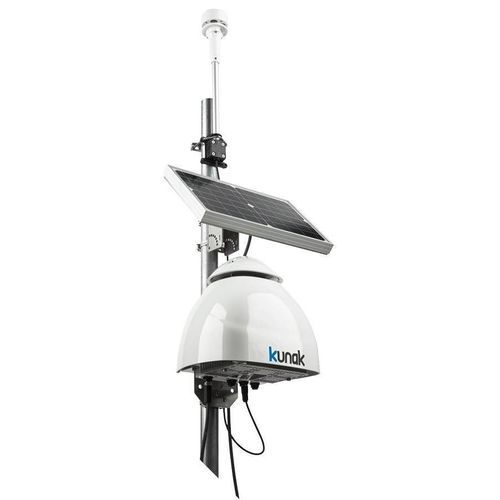
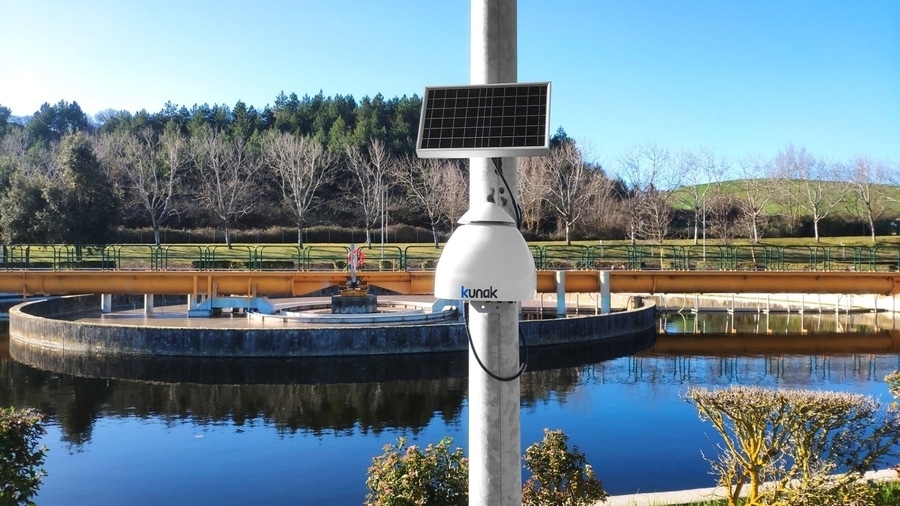
Kunak’s solutions have been specifically designed for these scenarios. Its environmental monitoring stations enable continuous measurement of critical gases associated with odor and emissions, together with meteorological variables, using autonomous equipment with flexible deployment options.
The modularity of the sensors, the ability to relocate them as plant conditions evolve, and centralized data management allow these networks to be easily integrated into daily operations. It is not about “installing sensors”, but about integrating environmental data into plant control.
Large-scale experiences, such as projects developed in wastewater treatment plants in Oman, show that this approach is viable even in demanding climates and across multiple facilities. The key has been the availability of comparable, continuous, and contextualized data capable of explaining why an episode occurs and how to prevent it from happening again.
From reactive control to data-driven management
Odor management in WWTPs is changing. Continuous monitoring does not eliminate the problem on its own, but it makes it possible to understand it, anticipate it, and manage it more precisely. In a sector where every decision has operational, environmental, and social implications, having reliable data makes a real difference.
Turning odor into information is the first step toward moving away from firefighting and toward technically sound, proactive management.
If you manage a WWTP and want to move from reaction to anticipation, it is time to incorporate continuous environmental monitoring as part of the plant’s real operational control. Measuring properly is deciding better.